STEAM
STEAM
Science - Technology - Art - Math
What is STEAM?
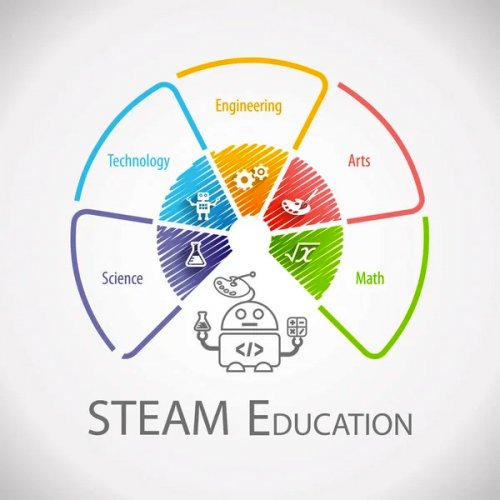
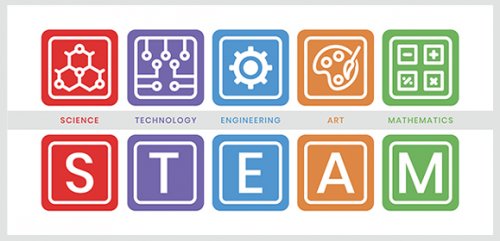
In its most basic form, STEAM stands for Science, Technology, Engineering, and Mathematics. But STEAM education is much more than just combining the titles of the subject areas. It is an educational philosophy that embraces skills and teaching subjects in an experiential way, close to reality.
The world we live in requires an increasing amount of skills and knowledge, starting from digital skills, but not only.
Therefore, an approach that values the contribution of scientific subjects in understanding the functioning of the world we live in is necessary. Investing in STEAM does not only mean valuing the importance of these disciplines in a traditional sense. Rather, it means especially making use of and adopting the tools – especially cognitive ones – of the sciences, which are essential in advanced societies.
It is a new teaching method that can complement traditional lectures, with a laboratory and cooperative approach. Integrating the contributions of scientific disciplines more and more with those of other subjects.
Contaminating viewpoints and approaches offered by different disciplines means developing a teaching method that values – alongside the analytical rigor typical of the sciences – also the creativity and curiosity of students. Traditionally, scientific subjects are perceived as a separate world from the rest of the educational curriculum.
The first effect is a low percentage of young graduates in STEM disciplines compared to the European average, which is accompanied by a low percentage of young graduates overall. This leads to a depletion of the existing human capital in our country. The second is an increase in gender disparities. Due to social stereotypes, in particular female students remain a minority in scientific paths. That is, those that in today’s economies guarantee greater job stability and higher salaries in the future. STEAM is the tool to combat the gender gap by offering our daughters real freedom of choice.
To introduce the STEAM approach into our educational path, we have designed and planned various activities (lectures, laboratories, experiences, gaming, cooperative work), progressively starting from preschool to the end of secondary school (clearly graduated and defined for age groups), according to coherent and coordinated principles and developments in the different subject areas and in the various educational and teaching moments.
The STEAM approach is completed and refined through:
- The teaching activity of coding, applied throughout the educational path. - The computer laboratories of the Primary School and Best Middle - The activities of Best Middle for obtaining the ICDL – ECDL, the European Computer Driving License.